Arcana Unleashed Book Review
Table of Contents

The Alternate Cover Immediately Caught My Attention
The standard cover is attractive, but the alternate cover was the one I wanted to bring home. It shows the symbol of Mystra, the goddess of magic, surrounded by the symbols of the eight schools of magic. That feels like a perfect visual summary for a book built around arcane traditions, magical factions, and different ways to shape a character around the Weave.
Comparing It With Strixhaven

Side note: when I picked up my copy, it immediately made me think of the alternate cover for Strixhaven: A Curriculum of Chaos. So here is a side by side comparison of both covers. Let me know if I am imagining the resemblance.
I genuinely thought the same artist had made both covers, but that is not the case. The alternate cover for Arcana Unleashed was made by CoupleofKooks, while the alternate cover for Strixhaven: A Curriculum of Chaos was made by Hydro74.
Do you see the resemblance too, or am I the only one?
A Smaller Book Than I Expected
The other thing I noticed as soon as I picked up Arcana Unleashed was its size. I expected it to feel closer to the recent Forgotten Realms: Heroes of Faerûn. That seemed like a reasonable comparison because this release also pairs a book with player options and a separate book aimed more at Dungeon Masters and adventures.
Instead, Arcana Unleashed is noticeably smaller. Heroes of Faerûn has 192 pages (and a detachable map), while Arcana Unleashed has 160 pages. That is 32 fewer pages, which means Arcana Unleashed is approximately 20% shorter by page count.
The book retails for $39.99 USD, which is the same MSRP as Forgotten Realms: Heroes of Faerûn. I thought that comparison was worth pointing out. It was not a deal breaker for me, but it did make me wonder whether Heroes of Faerûn offers better value, especially since it has 192 pages compared with the 160 pages in Arcana Unleashed. That is about 20% more content at the same price. Even so, page count does not determine whether a book is good or bad, and I think Arcana Unleashed is a strong book. I simply wanted to acknowledge the difference in value.
Oh, and there is no detachable map in the book, which was disappointing to see.
A Gameplay Expansion Without a Dedicated Setting
The distinction between Arcana Unleashed and the recent setting books is not only a question of branding. It is a design choice that I find genuinely interesting. You can take an Artificer from Eberron: Forge of the Artificer and play that character in the Forgotten Realms, or bring a subclass from Heroes of Faerûn into Ravenloft. D&D has always allowed that kind of mixing and matching, so the setting attached to a book has never been an absolute restriction (at least at my table).
Still, Arcana Unleashed makes the gameplay material itself the center of attention. Its subclasses, backgrounds, spells, and magic items do not require you to commit to one established world before they become useful. The factions and magical society in the book can give them context when you want it, but you can also treat them as ideas to adapt or leave aside.
I like that approach. Character options do not always need to arrive as part of a larger setting book, and a magic focused expansion can be useful to a much wider range of campaigns when it is presented this way. It makes Arcana Unleashed feel like a book about what characters can do first.
What Is Inside the Book?
Arcana Unleashed begins with an introduction about a multiverse of magic. After that, it contains six chapters, an appendix, and the rule index.
The book is organized like this:
- Chapter 1 covers character options, including eight subclasses, ten backgrounds, and 20+ feats.
- Chapter 2 contains 33 new and revised spells.
- Chapter 3 explains how to create magical worlds, including magic in society, religion, technology, magical patrons, and archmages.
- Chapter 4 presents nine magical factions and the relationships between them: the Bejeweled Conclave, the Bringers of Cosmic Dawn, the Covenant of the Grave, the Crucible Keepers, the Horizon Weavers, the Ninth Quill, the Phantasmic Circus, the Seers of Sea and Sky, and the Sheltering Hands.
- Chapter 5 contains 47 magic items, including an evolving magic item system.
- Chapter 6 is the magical creatures section.
- The appendix contains the introductory adventure, Tomb of the Shadow Serpents.
A Look Inside the Book
The Decorative Interior

Introduction: A Multiverse of Magic

Chapter 1: Character Options

Chapter 2: Spells

Chapter 3: Creating Magical Worlds

Chapter 4: Magical Factions

Chapter 5: Magic Items

Chapter 6: Magical Creatures

Appendix: Tomb of the Shadow Serpents

Credits and Contents

Alustriel’s Notes Give the Book More Personality
The introduction, Alustriel’s Arcana, is presented as though Alustriel Silverhand assembled these ideas and observations herself. I like when a rules book feels as if an important character has left notes for the reader. Tasha’s Cauldron of Everything used a similar idea, with Tasha’s personality appearing throughout the book instead of leaving us with a completely neutral rules document.
That framing adds a little flavor to the reading experience. I can imagine finding the book somewhere in the world and reading through Alustriel’s explanations, opinions, and warnings. It does not change how the rules work, but it gives the material a stronger sense of place and makes the book feel more like an object from the D&D universe.
Chapter 1: Character Options
Arcana Unleashed gives us eight subclasses, which is the same number found in Forgotten Realms: Heroes of Faerûn and one more than Ravenloft: The Horrors Within.
Even though this is a book focused on magic, the options are not limited to spellcasters. The Warrior of the Mystic Arts gives Monks a magical path, while the Arcane Archer gives Fighters a way to bring magic onto the battlefield. I like seeing those two martial options included, because not everyone wants to play a Wizard, Cleric, or Warlock.
The eight subclasses are spread across only five classes. The Cleric gets the Arcana Domain, the Fighter gets the Arcane Archer, the Monk gets the Warrior of the Mystic Arts, and the Warlock gets the Vestige Patron. The Wizard gets four subclasses: the Conjurer, Enchanter, Necromancer, and Transmuter.
Before getting into my favorites, here is the short version of what each subclass is trying to do:
- Arcana Domain Cleric: A cleric who treats arcane knowledge as part of their divine calling. The subclass gains access to Wizard cantrips and eventually learns one Wizard spell each of levels 6, 7, 8, and 9.
- Arcane Archer Fighter: A martial character who channels magic through ranged attacks. Arcane Shots give the Fighter ways to alter attacks and control the battlefield from a distance.
- Warrior of the Mystic Arts Monk: A Monk who combines spellcasting with martial arts. It gains Sorcerer cantrips and spells, then learns to weave those spells into its attacks and Focus Point economy.
- Vestige Patron Warlock: A Warlock who makes a pact with a dying god. The patron appears as a Vestige Companion, so the character’s source of power is also a physical ally who needs help to regain its former strength.
- Conjurer Wizard: A Wizard who treats summoning and teleportation as two expressions of the same school. The subclass can reposition itself, swap places with allies, reinforce summoned creatures, and eventually call additional creatures into the fight.
- Enchanter Wizard: A Wizard who specializes in influencing minds. It can become a strong social character, apply charm and incapacitation, affect multiple targets, and eventually alter the memories of creatures it has enchanted.
- Necromancer Wizard: A Wizard who explores life, death, and undeath. It gains an undead familiar, resistance to necrotic damage, stronger undead summons, ways to ignore necrotic resistance, and the ability to recover its own vitality from its minions.
- Transmuter Wizard: A Wizard who reshapes bodies and matter. Its Transmuter’s Stone can grant darkvision, damage resistance, or increased speed, while later features improve transformation magic and can even restore fallen allies.
That distribution is both interesting and a little disappointing. Only the Warrior of the Mystic Arts and the Vestige Patron are new subclasses. The other six are updated versions of subclasses from fifth edition. The four Wizard options each represent one of the schools of magic, which means the Wizard now has a subclass for every school, plus the Bladesinger from Heroes of Faerûn. That gives the Wizard nine subclasses in the current rules.
It makes sense for a magic focused book to give the Wizard so much attention, but it also means that the variety is narrower than the total of eight subclasses first suggests. If you do not play a Wizard, you might feel that this chapter gives you fewer options than expected. I would have preferred to see some of those Wizard subclasses replaced with new options for other classes, even if that meant leaving a few schools of magic for a future release. I would especially have liked to see an option for the Sorcerer, Bard, or Druid. The Druid still does not have a subclass in this book, which feels like a missed opportunity for a class that can interact with magic in such a distinctive way.
I am not seeing any subclass that feels like a major failure. The options are flavorful, and the mechanics seem solid from what I have read so far. Here are my thoughts on my three favorite subclasses from the book:

The Arcane Archer looks like a fun choice for anyone who wants to play a ranged Fighter. Its Arcane Shot options give the class some exciting ways to bring magic into combat. My one hesitation is that Arcane Shot is tied to Intelligence. I think that is manageable, but it does make the subclass require a little more planning than it might otherwise need.

The Warrior of the Mystic Arts feels especially natural to me. It is nice to finally have a Monk subclass that can become a third caster. The base class benefits from having a good Wisdom score, so choosing a subclass that also uses Wisdom does not force the character to stretch their ability scores in a new direction. This feels different from playing something like an Eldritch Knight or an Arcane Trickster. With those subclasses, you need to think about the subclass at level one and put some points into Intelligence if you want to benefit from its mechanics later. The Warrior of the Mystic Arts does not create the same tension. The Monk is already encouraged to invest in Wisdom, so the magical specialization feels like a natural extension of the class rather than a separate requirement.

The Vestige Patron is probably my favorite subclass in the chapter. I am not usually drawn to playing a Warlock, but I really like the idea of making a pact with a dying god. A typical patron is a powerful entity that gives a Warlock magic in exchange for service, devotion, or some other kind of request. The Vestige changes that relationship into something closer to a collaboration. It was once a powerful god, but it now needs the Warlock’s help to recover its former strength. That dynamic is especially interesting because the patron is also the character’s companion. The Vestige Companion gives you a physical representation of the being that granted your powers, so the patron is present beside you instead of remaining an abstract voice or distant force. It creates an immediate roleplaying opportunity for the Warlock and the Dungeon Master, and it gives the relationship room to feel more symbiotic than transactional. The subclass feels strong, very thematic, and different enough from the other options to stand out. This is one of the subclasses that made me want to create a character and try it at the table.
Backgrounds and Feats
The chapter also includes ten new backgrounds. Nine of them are connected to the magical factions in the book, while the Familiar Trainer is the one background that is not tied to a faction. I like that connection between the background and the wider setting. Choosing a background such as the Agent of the Ninth Quill or the Bejeweled Conclave Spy gives you an immediate relationship with one of the groups that the book explains later.
I know backgrounds can still be controversial in the current rules. Your choice affects your ability scores and your Origin feat, so it can feel as though the best mechanical choice is deciding your character before you have finished imagining them. I understand why some players feel that this removes flexibility. The rules do give us the option to create a custom background, though, so we can still build the combination we want when a published background does not fit.
Personally, I like the restrictions. I do not use custom backgrounds at my table, whether I am playing or running the game. I enjoy having a clear package of mechanics connected to a specific piece of character flavor, and I have never had a problem with that approach at my table. My group may also influence that opinion. Most of the players I play with have been in D&D for only a year or two, so it is possible that more experienced players feel the limitations more strongly.
The backgrounds in Arcana Unleashed are especially good at adding flavor. I already mentioned how much I enjoy the scene art attached to them, but the faction connections make the backgrounds more useful for building a campaign. A character can arrive at the table with an existing relationship, a reason to care about faction rivalries, and a clear direction for their backstory.

The Bejeweled Conclave Spy is one of the backgrounds that caught my attention. Its Arcane Eloquence Origin feat gives you the Vicious Mockery cantrip and lets you add 1d4 to Deception, Intimidation, and Persuasion checks. That is a great fit for a character who relies on social interaction, and I like options that reward roleplaying in campaigns where those kinds of checks happen often.

My favorite is probably the Agent of the Ninth Quill, which gives you the Arcane Infiltrator Origin feat. The feat gives you the Friends cantrip and lets you take the Dodge action as a Bonus action a number of times equal to your Proficiency Bonus. Being able to Dodge as a Bonus action is strong, but the part I like most is that it makes an action I rarely see used more appealing.
At my table, players usually attack when they have an action available. It is not common for someone to stop and consider the other actions they could take on their turn. Turning Dodge into a Bonus action makes it much more enticing, and it may help players discover how useful that action can be. Even if a future character does not have the Arcane Infiltrator feat, the player might remember how useful Dodge was and choose it as an action in another situation.
That is the kind of design I enjoy. The feature is not only useful on the character that gets it. It can also teach players more about the game by encouraging them to try something they might otherwise ignore.
The feat selection is also broad. By my count, the book contains ten Origin feats, fifteen General feats, three Epic Boon feats, and one Fighting Style feat. The Fighting Style feat is Arcane Warrior, which lets you learn two Wizard cantrips, choose Intelligence, Wisdom, or Charisma as your spellcasting ability for them, and replace one of the cantrips whenever you gain a level.
I did not expect a Fighting Style feat to give you cantrips, but I think it is a good addition. Cantrips can add a lot of flexibility when used for utility. Having more options can make a martial character feel more connected to the magical theme of the book. This feat will also become better as more cantrips are added in future book releases.
Overall, I like the backgrounds and feats. The backgrounds are flavorful, the faction connections give them a place in the setting, and the feats offer a nice range of mechanical options. I still understand why some players prefer custom backgrounds, but I like the structure these published backgrounds provide.
Chapter 2: Spells

Chapter 2 contains 33 new and revised spells. They range from level 2 to level 9, so there are no new cantrips or level one spells in this chapter. I wanted to look at the distribution a little more closely, both to see which schools of magic receive the most support and to see which classes can actually use these spells.
The number of high level spells also makes more sense when I look at Arcana Unleashed together with Arcana Unleashed: Deadfall. The second book is a high level adventure for characters from level 11 to level 20, so the two releases give a group both new magical tools and an adventure where those tools can actually matter. A character created with the options in Arcana Unleashed can bring those spells into an adventure designed for the levels where many of them become available.
I am happy to see that emphasis. We already have a lot of low level spells, so adding more options for experienced spellcasters makes the book feel useful beyond the first few tiers of play. The spell list still has a good variety of schools and effects, but it also gives high level characters new reasons to open their spellbooks.
The table below shows the spell level, school, and class spell lists for each option. I am counting access through a class’s spell list here, not access through a subclass feature, Magical Secrets, a feat, or another special ability.
| Level | Spell | School | Class spell lists |
|---|---|---|---|
| 2 | Battle Familiar | Conjuration | Druid, Warlock, Wizard |
| 2 | Disruptive Tune | Abjuration | Bard, Sorcerer, Wizard |
| 2 | Dueling Ground | Abjuration | Artificer, Bard, Cleric, Druid, Paladin, Ranger, Sorcerer, Warlock, Wizard |
| 2 | Uncertain Footing | Illusion | Artificer, Bard, Warlock, Wizard |
| 2 | Wither and Bloom | Necromancy | Druid, Sorcerer, Wizard |
| 3 | Catnap | Enchantment | Artificer, Bard, Sorcerer, Wizard |
| 3 | Inflict Doubt | Enchantment | Bard, Sorcerer, Warlock, Wizard |
| 4 | Distorted Distance | Illusion | Artificer, Bard, Warlock, Wizard |
| 4 | Festering Blast | Necromancy | Druid, Sorcerer, Warlock, Wizard |
| 4 | Zone of Amicability | Enchantment | Bard, Warlock |
| 5 | Enervation | Necromancy | Sorcerer, Warlock, Wizard |
| 5 | Grave Ground | Necromancy | Cleric, Warlock, Wizard |
| 5 | Mordenkainen’s Lucubration | Divination | Wizard |
| 5 | Negative Energy Flood | Necromancy | Warlock, Wizard |
| 5 | Spirit Lantern | Necromancy | Artificer, Cleric, Warlock, Wizard |
| 5 | Summon Plant | Conjuration | Druid, Ranger |
| 5 | Waves of Exhaustion | Necromancy | Sorcerer, Warlock, Wizard |
| 6 | Summon Dinosaur | Conjuration | Druid |
| 7 | Aura of Evasion | Abjuration | Sorcerer, Warlock, Wizard |
| 7 | Fractured Awareness | Divination | Bard, Sorcerer, Warlock, Wizard |
| 7 | Power Word Pain | Enchantment | Bard, Sorcerer, Warlock, Wizard |
| 7 | Reweave Fate | Divination | Bard, Cleric, Warlock, Wizard |
| 7 | Transfix | Enchantment | Bard, Warlock, Wizard |
| 8 | Entrancing Mirrors | Illusion | Bard, Sorcerer, Warlock, Wizard |
| 8 | Illusory Dragon | Illusion | Wizard |
| 8 | Iron Body | Transmutation | Sorcerer, Warlock, Wizard |
| 8 | Lightning Ring | Evocation | Druid, Sorcerer, Warlock, Wizard |
| 8 | Moment of Prescience | Divination | Wizard |
| 9 | Detonate | Evocation | Sorcerer, Warlock, Wizard |
| 9 | Hindsight | Divination | Wizard |
| 9 | Invulnerability | Abjuration | Wizard |
| 9 | Vision of Elapsing Eons | Illusion | Bard, Sorcerer, Warlock, Wizard |
| 9 | Wail of the Banshee | Necromancy | Sorcerer, Warlock, Wizard |
How the Spells Are Distributed
There are only two level 3 spells and one level 6 spell, while level 5 has seven spells. There are five spells at each of levels 7, 8, and 9. In total, 18 of the 33 spells are level 5 or higher, which means more than half of this chapter is aimed at characters who have already reached the higher tiers of play.
| Spell level | Number of spells | Share of all spells |
|---|---|---|
| 2 | 5 | 15.2% |
| 3 | 2 | 6.1% |
| 4 | 3 | 9.1% |
| 5 | 7 | 21.2% |
| 6 | 1 | 3.0% |
| 7 | 5 | 15.2% |
| 8 | 5 | 15.2% |
| 9 | 5 | 15.2% |
Necromancy is the most represented school, with eight spells. Divination, Enchantment, and Illusion each have five. The school with the least representation is Transmutation, which has only Iron Body. That does not necessarily mean the chapter lacks variety, because the spells within each school do very different things, but it does show how strongly the book leans toward necromantic magic.
| School of magic | Number of spells | Share of all spells |
|---|---|---|
| Necromancy | 8 | 24.2% |
| Divination | 5 | 15.2% |
| Enchantment | 5 | 15.2% |
| Illusion | 5 | 15.2% |
| Abjuration | 4 | 12.1% |
| Conjuration | 3 | 9.1% |
| Evocation | 2 | 6.1% |
| Transmutation | 1 | 3.0% |
Looking at class access makes the Wizard’s position in this book even more obvious. The Wizard can access 30 of the 33 spells. The Warlock can access 23, and the Sorcerer can access 17. The Bard can access 13, while the Artificer, Cleric, Druid, Ranger, and Paladin have much smaller selections. The Paladin only gets Dueling Ground, while the Ranger gets Dueling Ground and Summon Plant.
| Class | Spells available | Share of all spells |
|---|---|---|
| Wizard | 30 | 90.9% |
| Warlock | 23 | 69.7% |
| Sorcerer | 17 | 51.5% |
| Bard | 13 | 39.4% |
| Druid | 7 | 21.2% |
| Artificer | 5 | 15.2% |
| Cleric | 4 | 12.1% |
| Ranger | 2 | 6.1% |
| Paladin | 1 | 3.0% |
These numbers reinforce the impression from Chapter 1. Arcana Unleashed is a book about magic in general, but the player options are especially generous to Wizards and Warlocks. That is understandable, and it is probably what many readers expect from the theme, but it is worth remembering if you are buying the book for a specific class.
Summon Dinosaur Is My Favorite Spell So Far
My favorite spell in the chapter is Summon Dinosaur. You cast the spell and call forth a dinosaur spirit, choosing between an Ankylosaur, a Triceratops, or a Tyrannosaurus Rex. Each form gives the spirit a different role, so the spell is not only a fun visual idea.
The summoned dinosaur shares your initiative and acts immediately after you. It follows your verbal commands without requiring an action, and if you do not give it an order, it takes the Dodge action and avoids danger. That makes it simple to run while still feeling like a real ally on the battlefield.
I know there are more complicated and probably more powerful spells in the chapter, but there is something very appealing about having a dinosaur appear in the middle of a fight. This is exactly the kind of spell that makes a book feel fun. It gives you a clear image, a memorable character moment, and a practical combat tool at the same time.
Power Word Pain Is a Great Villain Spell
Another spell that caught my attention is Power Word Pain, a level seven Enchantment spell available to Bards, Sorcerers, Warlocks, and Wizards. It deals 6d8 Force damage, and a creature with 100 Hit Points or fewer also gains the Charmed condition for one minute. While the target is affected, its Speed is limited, most of its D20 Tests have Disadvantage, and casting a spell requires a Constitution saving throw or the spell is wasted.
The target gets a chance to end the effect at the end of each of its turns, but this still feels like a terrifying spell to put in the hands of a major villain. I like the image of a BBEG using a single word to lock down one of the heroes while the rest of the party tries to break through the encounter. It is powerful, memorable, and exactly the kind of high level magic that can give a boss fight its own identity.
Lightning Ring Turns the Caster Into a Storm
Lightning Ring is another high level spell that looks like a lot of fun. It is an eighth level Evocation spell with a range of Self, a casting time of a Bonus action, and a duration of Concentration up to 10 minutes. It creates a ten foot Emanation around the caster, dealing 3d6 Lightning damage and 3d6 Thunder damage when creatures fail a Constitution saving throw after entering the area or ending their turn there.
While the ring is active, the caster can also use a Magic action to send a 60 foot line of lightning through the battlefield. Creatures in the line make a Dexterity saving throw or take another 6d6 Lightning damage. That combination gives the spell a strong identity: the caster can move into the middle of a fight, punish creatures that stay nearby, and still use an action to attack at range.
I really like this kind of spell design. It asks the player to think about movement and positioning, but it also gives them something exciting to do with their Bonus action and Magic action. Together with Power Word Pain and Summon Dinosaur, it reinforces my impression that the spell chapter has a lot of memorable options for high level play.
Chapter 3: Creating Magical Worlds
This chapter is about creating a magical world of your own. It gives examples of existing settings such as Dragonlance, Eberron, the Forgotten Realms, Greyhawk, and Ravenloft, with short descriptions and references to the sourcebooks where you can find more inspiration. I like that approach because these settings show several different ways to build a world around magic without asking you to copy any one of them directly.
The chapter also asks useful questions about how magic fits into everyday life. Is magic seen as something wonderful, or is it feared and outlawed? What role do religion and technology play in the setting? Are there laws that control magic, businesses that depend on it, or mage guilds that train and regulate spellcasters? Does the world rely on magical armies, and how do people defend themselves against powerful mages?
Those questions make the chapter useful even if you already have a setting in mind. A magical society is not only a place where spells exist. It is a place where people have developed opinions, customs, institutions, and rules around those spells. Thinking about those details can help a setting feel more lived in and can give you ideas for conflicts that are not simply about fighting a monster.
I also enjoyed the chapter’s discussion of how people learn magic. An apprentice might study at an academic school, learn through a cultural tradition, or be trained by a powerful mentor. The book also considers how a castle might defend itself against an Archmage, including the difference between ordinary walls and defenses designed specifically to resist magic. These examples show how magical ideas can affect architecture, education, politics, and daily life.
The chapter includes several options for magical patrons, including Archmages, tricksters, and political factions. It also explains how to create your own factions, which connects naturally to the organizations described in Chapter 4. A faction can be a school, a religious movement, a secret society, a military power, or a group with a completely different relationship to magic. That gives a Dungeon Master a useful starting point for building conflicts and alliances around the setting.
This is clearly a chapter aimed more at Dungeon Masters and Game Masters than players, but I found it concise and easy to read. It does not try to create a complete setting for you. Instead, it gives you questions, examples, and ideas that can help you decide what kind of magical world you want to build. Every section feels purposeful, and the chapter does not feel bloated.
Chapter 4: Magical Factions

Chapter 4 is about the magical factions, and it connects directly to the backgrounds from Chapter 1. Nine of the ten backgrounds are associated with one of these factions, so this is where the book gives more context to the organizations that characters can join. The previous chapter’s advice about building magical worlds makes these factions easier to adapt to your own setting, but they are also useful as written.
There are nine factions in total. Eight of them are associated with one of the schools of magic, while the Ninth Quill is a more general organization focused on knowledge, espionage, and magical artifacts. Here is the short version of what each faction is about:
- Bejeweled Conclave, Enchantment: These discreet enchanters make themselves valuable to powerful clients as entertainers, advisors, and mediators. At the same time, they collect the secrets of the people who hire them.
- Bringers of Cosmic Dawn, Transmutation: This reclusive group is obsessed with mutation and transformation. Its members experiment on themselves and seek guidance from alien intelligences, which does not make them especially popular with the other factions.
- Covenant of the Grave, Necromancy: The necromancers of this faction study the dead and undeath with scientific precision. Their rigorous research is meant to uncover esoteric knowledge, even when the subject matter makes other people uncomfortable.
- Crucible Keepers, Evocation: The Crucible Keepers study natural disasters, from volcanic eruptions to powerful hurricanes, while searching for increasingly ambitious applications of evocation magic.
- Horizon Weavers, Conjuration: These conjurers explore and chart the multiverse. They approach summoning and teleportation as tools for discovering places that few other people can reach.
- Ninth Quill: The Ninth Quill is a faction of spies and saboteurs who acquire lore and artifacts from powerful mages. Some members want to protect dangerous treasures, while others are motivated by greed. They also encourage tension between the other factions so that none of them becomes too powerful.
- Phantasmic Circus, Illusion: The showy illusionists of the Phantasmic Circus entertain eager audiences with impossible spectacles. This faction gives illusion magic a joyful and theatrical identity.
- Seers of Sea and Sky, Divination: These diligent oracles search for truth in the movement of wind and waves. Their connection to the natural world gives divination a patient, observant, and almost poetic flavor.
- Sheltering Hands, Abjuration: The abjurers of the Sheltering Hands uplift the downtrodden and protect people in need. Their faction shows that defensive magic can be about community care as much as personal survival.
I like how quickly these descriptions communicate each faction’s identity. You can understand the kind of stories they create without reading several pages of setting history, and the school associations make it easy to imagine where a character might belong.
Finding a Place for Every Character
It would have been easy for the book to make the factions useful only to Wizards and other spellcasters. Instead, it includes guidance about which classes might be drawn to each organization. A Barbarian could become a Crucible Keeper, a Monk might find a place among the Covenant of the Grave or the Sheltering Hands, and a Rogue could work with the Bejeweled Conclave or the Ninth Quill.
That small effort makes the factions feel broader than their magical specializations. A character does not need to cast spells to have a reason to join one. They might be interested in the faction’s methods, its facilities, its politics, or the kind of work it sends its members to do. This is especially useful for building a party with different classes, because everyone can have a connection to the same magical world without belonging to the same kind of character.
The chapter also explains how to join a faction and how characters can take on quests for them. As their renown grows, characters gain access to different rewards and benefits. The Ninth Quill, for example, can provide embarrassing information about another person at a lower level of renown and much more valuable secrets after the character has earned a stronger reputation.
I like that renown is not only presented as an abstract score. It gives the faction relationship a practical effect in the campaign. A character’s connection can provide information, favors, items, or new story opportunities, which makes the organization feel like more than a paragraph in a backstory.
Faction Relationships Create Campaign Tension
The relationships between the factions are another strong part of the chapter. The book shows which organizations are friendly toward one another and which are hostile. That gives a Dungeon Master an immediate foundation for alliances, rivalries, and enemies, while a solo player can use the same information to generate complications around a character’s faction allegiance.
A mission for one group can become more interesting when another group wants the same artifact, disagrees with the first faction’s methods, or tries to use the player character as an intermediary. The Ninth Quill’s habit of encouraging dissent is particularly useful here because it gives the faction a reason to interfere even when it is not directly pursuing the same objective.
This is exactly the kind of worldbuilding I like in a gameplay expansion. The factions are specific enough to inspire a character or an adventure, but concise enough that I can understand the structure quickly. I do not feel as if the chapter is asking me to memorize a huge amount of lore. I can read through it fairly quickly and still come away with several campaign ideas.
Chapter 5: Magic Items

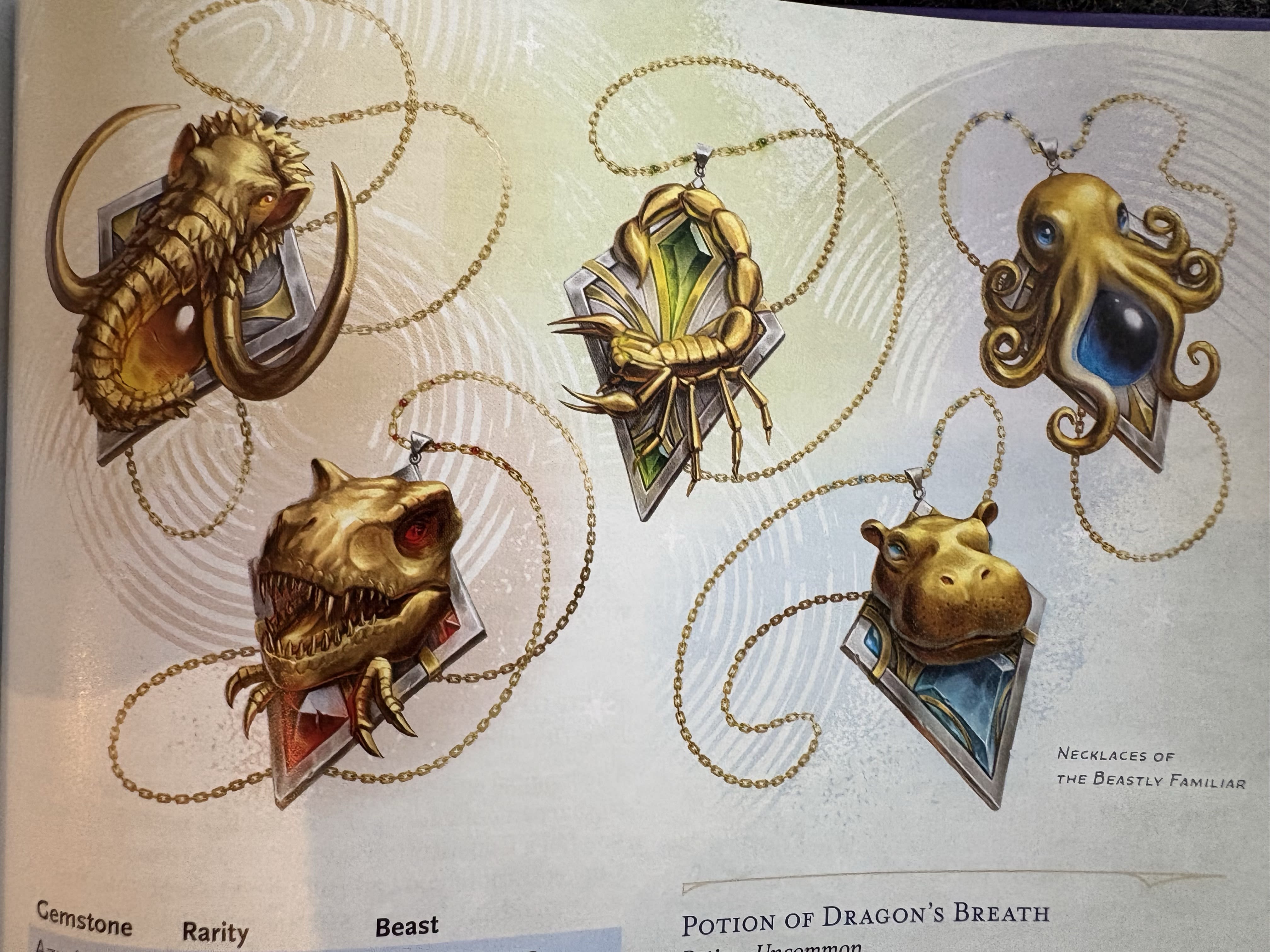
Chapter 5 contains 47 magic items, although that number does not tell the whole story. Some entries have several variants with different rarities and abilities. The Necklace of the Beastly Familiar is one example: it is a single magic item concept with different versions depending on the creature and the rarity. That means the book offers a little more variety than a simple count of 47 entries suggests.
The items cover a wide range of rarities, from Common items all the way to Very Rare and Legendary treasures, with some Artifacts included as well. I like having that spread. There are small, useful rewards for lower level characters, but there are also items that can become central to a high level character or a major villain.
The Blood Amulet Is a Great Enemy Treasure
The Blood Amulet is one of the items that caught my attention immediately. The image is fantastic: it looks like a small beating heart impaled with rusty nails, which is exactly the kind of visual that makes a magic item memorable before I even read its rules.
The Blood Amulet has three charges and can spend one whenever its wearer deals damage to a creature. The target then takes an extra 2d10 Necrotic damage and must make a DC 15 Constitution saving throw. On a failed save, it gains one level of Exhaustion. That is a significant effect, especially when a powerful enemy uses it against the party.
I often like giving strong enemies magic items instead of relying only on their stat blocks. An item such as the Blood Amulet gives a villain another memorable ability and gives the players a treasure they can claim after the fight. I think players usually appreciate finding an item this way more than discovering it in a chest behind a secret door. When a dangerous enemy uses a distinctive magic item during combat and the party defeats them, taking that item afterward feels like a real victory. It was part of the enemy’s identity, and now it belongs to the characters.
Small Items Can Still Create Fun Moments
The chapter also includes simpler items that can be useful at lower levels. The Potion of Tirelessness, for example, lets the drinker go without sleep and prevents magic from putting them to sleep for 24 hours. That is not as dramatic as a cursed staff or a legendary artifact, but it could be a great reward before a night watch, an infiltration, or a journey where the party cannot safely rest.
I like seeing items like this alongside the more powerful treasures. Not every reward needs to change the balance of a combat encounter. Sometimes an item is memorable because it solves a specific problem or creates an unusual approach to an adventure.
The Staff of the Lost Is Wonderful Trouble
The Staff of the Lost is probably my favorite item in the chapter from a flavor perspective. It is a Very Rare staff that requires attunement. It can be used as a magic Quarterstaff with a +1 bonus to attack and damage rolls, and it has charges that allow the wielder to cast Maze or Teleport.
The staff becomes nonmagical when its last charge is expended, but that is not the only risk. It is cursed, and an attuned character is unwilling to part with it. While cursed, the character never knows which direction is north and has Disadvantage on Wisdom (Survival) checks made to navigate. Whenever the wielder spends a charge, there is also a chance that one or more Minotaur materializes within 30 feet and immediately enters combat with them.
That is such a fun combination of mechanics and theme. The staff can help you escape with Teleport or send you through a Maze, but it also makes you lose your sense of direction and connects the item to the Minotaur of Greek mythology. The curse is not just a generic penalty attached to a powerful object. It tells you what kind of story the item wants to create, and it can turn every use of the staff into a new problem.
Evolving Magic Items Let Players Keep Their Treasures
The chapter also includes rules for creating custom evolving magic items. You can use an existing item from the Dungeon Master’s Guide as a starting point, then give it new powers as the campaign progresses. A simple evolution might increase a weapon or armor bonus from +1 to +2 and eventually +3. A more complex evolution can move an item from Common to Uncommon, Rare, Very Rare, or another rarity while adding new properties that fit its history.
I think this is a very good idea. It is common for a player to become attached to a particular item during a campaign, only to replace it as soon as the group finds a mechanically stronger version. A +1 longsword might have been part of an important early victory, but it can quickly become irrelevant when a better sword appears.
Evolving magic items give the Dungeon Master a way to preserve that history. Instead of throwing away the reward from an earlier adventure, the player can watch it grow alongside the character. New properties can reflect the places the item has visited, the enemies it has defeated, or the relationship that has formed between the item and its wielder. I like the idea of a campaign where the party’s most important treasures are not always the newest objects they find, but the ones that have stayed with them the longest.
Overall, the magic item chapter looks excellent. It has enough variety to serve different levels of play, includes items that can define an enemy or an adventure, and gives Dungeon Masters useful guidance for building treasures that grow with a campaign. I am looking forward to using some of these items as rewards, complications, and tools for creating memorable encounters.
Chapter 6: Magical Creatures

Chapter 6 is a compact bestiary with 19 magical creatures. It has a few stat blocks that are useful immediately, along with several creatures that give the Dungeon Master tools for creating encounters around the book’s central idea of magic becoming something strange and dangerous.
Archmages Make Useful High Level Enemies
The bestiary includes an Archmage for each school of magic. That means we get an Abjurer Archmage, Conjurer Archmage, Diviner Archmage, Enchanter Archmage, Evoker Archmage, Illusionist Archmage, Necromancer Archmage, and Transmuter Archmage. They are all Challenge Rating 15 creatures with close to 200 Hit Points, although some have a little more or a little less.
Each one has powerful abilities, multiattacks, and features that reflect its school. At first I was not sure I needed eight versions of an Archmage, but I have come around to the idea. They are ready to use, and it is useful to have a powerful spellcaster that already has a clear magical identity instead of having to build one from scratch.
The limitation is that, after reading through all eight, some of them can feel a little similar. That is not a major problem because they are meant to fill a similar role, but the variety is more about the school specific abilities than about completely different encounter concepts. I think they work well as a group of reliable high level enemies, even if they are not the most surprising creatures in the chapter.
A Few Other Powerful Creatures
The bestiary also includes creatures that sit outside the Archmage group. The Baelnorn is a much more powerful undead spellcaster with a Challenge Rating of 18. It is the kind of creature that can serve as a major guardian, an ancient magical figure, or a powerful presence in a location connected to lost knowledge.
Darkenbeasts are another memorable idea. They are ferocious creatures created from ordinary animals by sinister spellcasters, so they feel like beings that never chose to become part of a magical experiment. That gives them an unsettling quality. They are not simply dangerous beasts. They are evidence that someone used magic in a way that permanently changed another living creature.
Groundlings are smaller, aggressive creatures that function well as muscle for a magical villain. The book includes three variants: the Groundling Grunt, the Groundling Stalker, and the Groundling Slayer. That is a nice way to use the same basic concept at different levels of difficulty and give a group of enemies a little more variety than repeating one stat block several times.
Living Spells Are the Most Reusable Idea
The most interesting part of this chapter for me is the Living Spells section. The basic idea is wonderfully strange: magical energy released during a catastrophic experiment or event can give a spell a life of its own. Instead of being an effect that disappears after it resolves, the spell becomes a creature that can move, fight, and cause problems of its own.
The book provides three examples: Living Thunderwave, Living Vitriolic Sphere, and Living Cone of Cold. They mostly use a similar structure, with traits such as being Amorphous and having Magic Resistance. The damage immunity can be changed to match the spell’s damage type, so a Living Fireball could have immunity to Fire instead of using the damage type from one of the examples.
What makes this especially useful is that the three examples are built for different spell levels. One template is intended for a level one or level two spell, another is designed for a level three or level four spell, and the last is built around a level five spell. That gives the Dungeon Master a clear starting point when creating a Living Spell from another spell. You can choose the template that matches the spell’s level, then adjust the Hit Points, damage, attacks, and other details to fit the effect.
I love the amount of story potential this creates. I can imagine a dungeon where every spell cast in a particular chamber has a chance of becoming a Living Spell. Perhaps the party enters a temple divided into rooms dedicated to different schools of magic, and casting an Evocation spell in one room causes that spell to become hostile. The players would have to decide whether the effect is worth the risk, or whether they should find another way through the room.
That kind of rule creates an immediate adventure problem. It encourages players to think differently about their spell choices, and it gives the Dungeon Master a simple way to turn the environment into an active threat. The Living Spells are not only three monsters to add to an encounter table. They are a tool for making magic itself unpredictable.
The Art Is Incredible
The artwork is the first thing that impressed me. I have felt this way about most of the D&D books released for the current rules update. The art is often evocative enough to create a character, location, or encounter idea before I have even finished reading the page.

Two of my favorite pieces in this book are the art for the Vestige Patron and the updated Necromancer Wizard. Both images communicate a strong identity immediately. They make me want to know who these characters are, what happened to them, and what kind of story would lead someone to use these powers.
I also really like the scene art used for the backgrounds. It gives those options more flavor than a short mechanical description could provide. My favorite background image so far is the one connected to the Cosmic Dawn Experiment. It has the kind of visual energy that makes me want to build an entire character and campaign around the idea.

Not every illustration works equally well for me. Some pieces, including the illustration on page 29, use a more childish and cartoonish style that feels less striking beside the more dramatic artwork. That is a matter of taste, but the difference is noticeable to me.

The variety is still one of the book’s strengths. On page 37, a Red Wizard using the Detonate spell has a style that feels closer to a superhero comic. Other pieces are joyful, strange, serious, or dark. The art does not settle into one mood, which makes sense for a book about every part of magic.
A Great Reading Experience
The layout is another area where I think the current D&D books have improved. Information is easier to scan, and the overall page presentation makes it easier to find what I am looking for. The text is easier to follow, headings stand out clearly, and the pages do not feel as dense even when they contain a lot of rules.
This is one of the reasons I still enjoy buying physical books instead of only purchasing the content on D&D Beyond. D&D Beyond is often cheaper, and the Maps VTT has gained a lot of useful quality of life improvements. It is easy to use when I am playing as a player or running a game as a Dungeon Master.
Reading a book through the D&D Beyond reader is still not the same experience, though. The physical layout feels more deliberate, and I find it easier to flip through several pages and notice connections between sections. If the reader presentation improves, especially on desktop, I might feel differently. For now, the digital version is more practical in some situations, but the physical book is more enjoyable to read.
Appendix: Tomb of the Shadow Serpents
One pleasant surprise was finding Tomb of the Shadow Serpents in the appendix. It is a level one adventure designed to take one or two sessions. It can fit into any region that includes a forest and a cave, so it should be easy to place in almost any setting.
I do not want to say much more about the adventure because I do not want to spoil it. The important point for this review is that I was not expecting an adventure at the end of the book, and I think it is a very welcome addition.
The adventure is only about seven or eight pages long, but it includes useful preparation guidance. The opening pages provide key plot points and tell the Dungeon Master to read the background, review the area, and bookmark the monsters needed to run the adventure. That is a small detail, but it is exactly the kind of quality of life improvement that makes an adventure easier to use.
My main criticism is that the adventure is designed for level one characters. A level three adventure would have been a much better fit for this book. The main reason many people will buy Arcana Unleashed is probably the character options, especially the subclasses. A short level three adventure would have given players a convenient way to test those options in a one shot.
The Dungeon Master could increase the challenge by adjusting the creatures, but I think the book should have done that work for us. It would have been satisfying to finish creating a new subclass character, invite friends to try a one or two session adventure, and use an adventure from the same book immediately.
The level one adventure is still a nice addition. I just think the book missed an opportunity to make it more useful for its main audience.
First Impressions
After going through the whole book, I think Arcana Unleashed is a really good book and a great buy for the right reader. It looks excellent, reads well, and contains a broad collection of magical material. The alternate cover is one of my favorites so far, the interior art is often fantastic, and the layout makes the physical book pleasant to use.
The book felt lighter than I expected when I first picked it up, but I no longer see that as a major problem. It has 160 pages, yet is packed with content. After reading through it, each page feels purposeful, and the whole thing is easy to move through. I read it quickly because I wanted to share this review, but I am excited to go back through it more slowly.
I appreciate this gameplay expansion being setting agnostic. Previous gameplay expansions gave their character options a strong connection to Eberron, the Forgotten Realms, or Ravenloft. Arcana Unleashed still offers factions and worldbuilding ideas, but it lets the subclasses and other rules material travel more easily between campaigns. I like having a book that can add magical options to a setting without asking me to adopt an entire setting along with them.
The subclass chapter also leaves me with a positive first impression. The distribution is uneven, especially with four Wizard options and none for the Sorcerer, Bard, or Druid, but I do not see a bad subclass in the group. The Vestige Patron is the one I am most eager to try because its dying god and physical companion create a relationship that feels different from the usual Warlock bargain.
I would have preferred fewer Wizard subclasses and at least one option for the Bard, Druid, and Sorcerer. I would even have accepted fewer martial subclasses if that had made room for those three classes. Since I spend about 95 percent of my time playing a martial character when I am not Dungeon Mastering, I am saying this despite martial characters being my favorite characters to play.
The announced Season of Champions release is D&D: World of Warcraft, so it is not the generic martial focused expansion I had been hoping for. I would still love to see something like Martial Unleashed or Combat Unleashed in the future, with more fighting styles, maneuvers, martial subclasses, combat focused creatures, and backgrounds built around different fighting traditions. Arcana Unleashed makes me want that kind of book even more because it shows how effective a focused gameplay expansion can be.
So, should you buy it? If you enjoy magic, Wizards, Warlocks, magical factions, and high level spellcasting, I think you will be more than happy with it. The book is especially useful if you want character options and magical ideas that can be moved between settings. If you mainly play martial characters, the value is less even, but the bestiary, magic items, factions, and general worldbuilding advice can still give you plenty to use.
Overall, I really enjoyed reading Arcana Unleashed. It is a fantastic gameplay expansion with strong art, useful rules, memorable character options, and enough flavor to inspire a campaign without forcing you to adopt a specific setting. I only wish the included adventure had been designed for level three characters so that it could have been a better one shot for testing the new subclasses. Even with that missed opportunity and my concerns about the price, I think it is a book worth getting. If you buy the physical edition, I prefer the alternate cover.
Subscribe to the newsletter
Never miss an article. Get the latest articles delivered straight to your inbox.
By subscribing, you agree to receive new article emails. You can unsubscribe at any time.Privacy Policy


