Unearthed Arcana: Hell Knight (Fighter)
Table of Contents

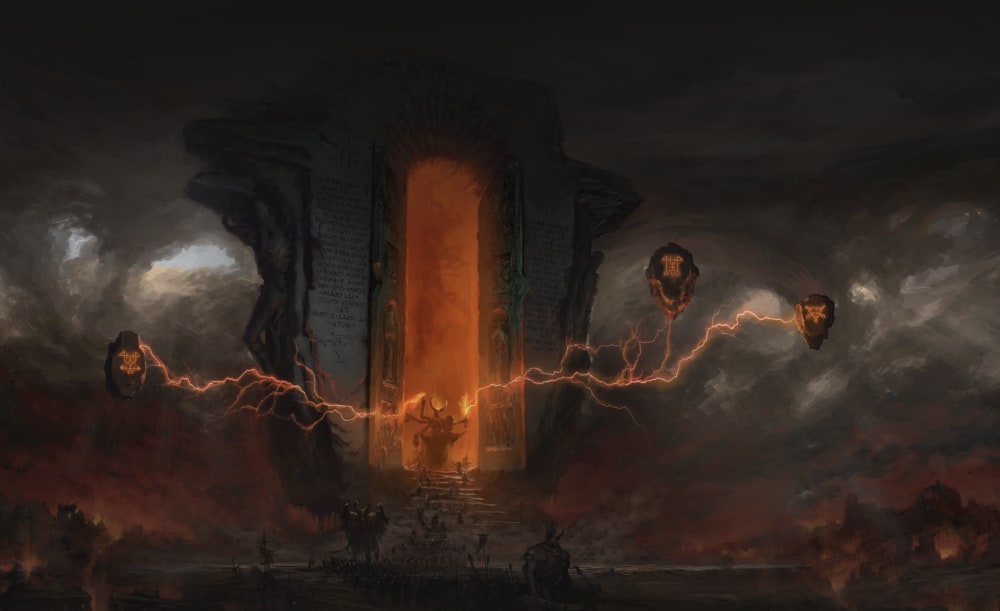
Art made by: trenchcrusade.com
Description
Hell Knights are the champions of archdevils and other high-ranking fiends of the Nine Hells, such as cambions and night hags. Armed with the techniques of the Nine Hells’ fiercest warriors, Hell Knights inflict infernal wounds and fight with the tenacity of a devil.
Devils and other sinister figures employ Hell Knights to enact their will across the multiverse. A Hell Knight might serve as a soldier on the front lines of the Blood War, while another might be tasked with punishing creatures that violate infernal contracts or flee their consequences. Others act as interplanar bounty hunters, hastening the journey of wicked souls to the River Styx.
A Hell Knight’s relationship with the Nine Hells is transactional. Archdevils see Hell Knights as an investment, and Hell Knights benefit in turn. The Hell Knight Pursuits table lists reasons why a Fighter might become a Hell Knight.
| 1d6 | You Became a Hell Knight Because You … |
|---|---|
| 1 | Desired treasures only the Nine Hells could grant you. |
| 2 | Hungered for power beyond mortal bounds. |
| 3 | Made a wager with a devil and lost. |
| 4 | Sacrificed your soul to spare someone else’s. |
| 5 | Sought vengeance on an adversary who wronged you deeply. |
| 6 | Were fooled by fine print in an infernal contract. |
Flavor-wise, this is really cool. I like the transactional relationship with devils, and the pursuit table does a lot of work in very little space. In just a few lines, it gives you a strong sense of why someone would become a Hell Knight. My first impression is that this subclass should be about dealing damage and layering negative effects on enemies, not boosting allies, so I was immediately curious to see whether the mechanics would deliver on that fantasy.
Level 3: Diabolical Gift
As a soldier for the agents of the Nine Hells, you’ve been given fiendish powers. You gain the following benefits.
Devil’s Sight. You can see normally in Dim Light and Darkness, both magical and nonmagical, within 120 feet of yourself.
Devil’s Tongue. You know Infernal, the language of devils. If you already know Infernal, you learn another language of your choice.
Devil’s Sight is just good. It is already a proven feature on Warlock, so getting it here at level 3 feels strong without stepping on that class too much. It is especially attractive for characters who do not already have Darkvision. Devil’s Tongue, meanwhile, is a ribbon, it’s fine. So far, this all feels thematic.
Level 3: Hellfire Weapon
When you take the Attack action, you can imbue one weapon that you are holding with hellfire, transforming it into a Hellfire Weapon. It remains transformed in this way for 10 minutes or until you use this feature again, you die, or the weapon is more than 5 feet away from you for 1 minute or more. You can also end this effect early (no action required).
While transformed into a Hellfire Weapon, a weapon emits Dim Light in a 5-foot Emanation, and whenever you deal damage with the weapon, it can deal your choice of Fire damage or its normal damage type.
This reads like a lot of text for a fairly simple payoff, but the payoff is still good: your weapon becomes an infernal flaming weapon for 10 minutes. That is easy to picture, and it fits the subclass well. On its own it is not spectacular, but it is the kind of core identity feature the rest of the subclass can build on.
Level 3: Infernal Wound
Your Hellfire Weapon can inflict infernal wounds.
Infernal Wound Die. You have one Infernal Wound Die, which is a d6.
Inflicting Infernal Wounds. Once per turn when you hit a creature with your Hellfire Weapon, you can deal extra Fire damage equal to one roll of your Infernal Wound Die and give the target an infernal wound.
While wounded in this way, the target takes Fire damage equal to one roll of your Infernal Wound Die at the start of each of its turns. This effect lasts for 1 minute, until the target regains Hit Points, or until the target or a creature within 5 feet of the target takes an action to stanch the wound. A target can be affected by only one instance of this feature at a time.
You can use this feature a number of times equal to your Constitution modifier (minimum of once). You regain all expended uses when you finish a Short or Long Rest.
The idea here is cool. Persistent infernal wounds fit the subclass fantasy perfectly, and the comparison to a stronger version of a burning effect makes immediate sense. My hesitation is that it already feels a little resource-tight. You only get a few uses per rest, it is still only once per turn, and if the die rolls low, the payoff can feel underwhelming. This is one of those mechanics that seems flavorful right away but might need tuning to feel consistently satisfying at the table.

Art made by: Alex Kuhn
Level 7: Advanced Wounds
When you roll your Infernal Wound Die and roll a 6, you can apply one of the following effects.
- Purulence of Minauros. Caustic pus erupts from the wound. Each creature in a 5-foot Emanation originating from the target takes Acid damage equal to your Constitution modifier, and the target has the Poisoned condition until the start of its next turn.
- Rupture of Cania. The wound ruptures with a spurt of arcane energy. The target takes Force damage equal to your Constitution modifier.
- Stygian Gangrene. Infernal rime spreads out from the wound. The target takes Cold damage equal to your Constitution modifier, and it can’t take Reactions until the start of its next turn.
This is where I start to feel the subclass is a little too dependent on die rolls. Triggering these effects only when you roll a 6 on the Infernal Wound die makes the whole package feel swingy, especially because these effects are important to the subclass’s identity. I do like the flavor a lot. Purulence of Minauros is gross in exactly the right way, and Stygian Gangrene is clearly more exciting because it adds both damage and a useful control effect. Rupture of Cania, by comparison, feels like it is missing something. As written, it looks like the weakest option by far.
Level 7: Hell-Forged Equipment
Your armor and weapons embody infernal armaments forged in the fires of Avernus, granting you the following benefits.
Fire Resistance. While wearing armor or wielding a Shield, you have Resistance to Fire damage.
Unholy Fire. Damage from your weapon attacks and Fighter features ignores Resistance to Fire damage.
I like the fire-resistance bypass more than the resistance itself. Fire Resistance is fine, but it reads more like expected infernal padding than a moment of excitement. Ignoring Fire Resistance, though, matters. If you are playing a hell-themed Fighter in a campaign full of fiends and fire, your signature damage type needs to keep working. That part lands well for me.
Level 10: Hellfire Surge
When you use your Action Surge while wearing armor or wielding a Shield, you can superheat your equipment, causing it to erupt with hellfire in a 10-foot Emanation originating from you. Each creature of your choice in the Emanation must succeed on a Dexterity saving throw (DC equals 8 plus your Constitution modifier and Proficiency Bonus). On a failed save, a target takes Fire damage equal to one roll of your Infernal Wound Die and is burning. On a successful save, a target takes half as much damage only.
This feels good in concept. Tying a burst of hellfire to Action Surge gives the subclass a real Fighter-specific moment, and setting multiple enemies on fire is exactly the kind of battlefield image I want from a Hell Knight. At the same time, this continues the pattern where the subclass feels flavorful but a little underpowered. A lot of the numbers still look modest for how late some of these features arrive.
Level 15: Blister of Avernus
Your hellfire leaves painful, boiling blisters. When you roll a 6 on your Infernal Wound Die, you can roll another d6 and add it to the damage. The maximum number of d6s you can add to the Infernal Wound’s damage on a turn is three.
I get the joke here. The cap of three extra d6s is clearly playing with the 666 infernal theme, and that is funny. Mechanically, though, this still leans too hard on rolling 6s in the first place. At level 15, I want the subclass to feel more reliable and explosive than this. As written, it still seems too easy for the big infernal payoff to just not happen often enough. (Also, it would kind of feel bad to cap a lucky streak ton only 3 success in a row).
Level 18: Hellfire Condemnation
Whenever damage from your Hellfire Weapon or Infernal Wound reduces a creature to 0 Hit Points, the creature dies, and its soul rises from the River Styx as a Lemure in a layer of the Nine Hells of your choice in 1d4 hours. If the creature isn’t revived before then, only a Wish spell can return the creature to life.
Flavor-wise, this is excellent. Mechanically, I am much less convinced. It is dramatic, but it does not feel like a level 18 payoff in actual play unless the campaign is deeply invested in soul mechanics, revival, and planar consequences. This is the sort of feature I would love as a story hook much earlier, but as a capstone-tier effect it feels thin.
Level 18: Infernal Bargain
When you roll your Infernal Wound Die, you can treat a roll of 1 as a 6.
This is useful, but it also highlights the core issue I have with the subclass. So much of the Hell Knight’s identity is locked behind rolling specific numbers on the Infernal Wound die. By level 18, I almost want the subclass to just fully unlock and let those effects happen freely or far more often. Overall, I like this subclass’s flavor a lot, but it feels like it still needs a balance and usability pass. The first two UA subclasses I looked at felt close to ready. This one feels more unfinished, and I would really like to see it reworked into something stronger and smoother because the concept deserves it.
Art made by: Richard WrightPro